
Latest + Greatest
June 2026
Teens Co-Create Discovery Session at TED Democracy
Co-authoring democracy: then, now, and tomorrow
A teenager chose an image that she know might cause strong feelings: a man crying under a banner that read HEAL, taken during the protests after George Floyd was killed. She was going to put it in the middle of a table of adults she had never met, most of them older than her parents, and ask them what they saw in it.
"I wasn't sure how that was going to go over with people," she said afterward. But she picked it anyway, because the invitation was to host a discussion about values that matter to her.
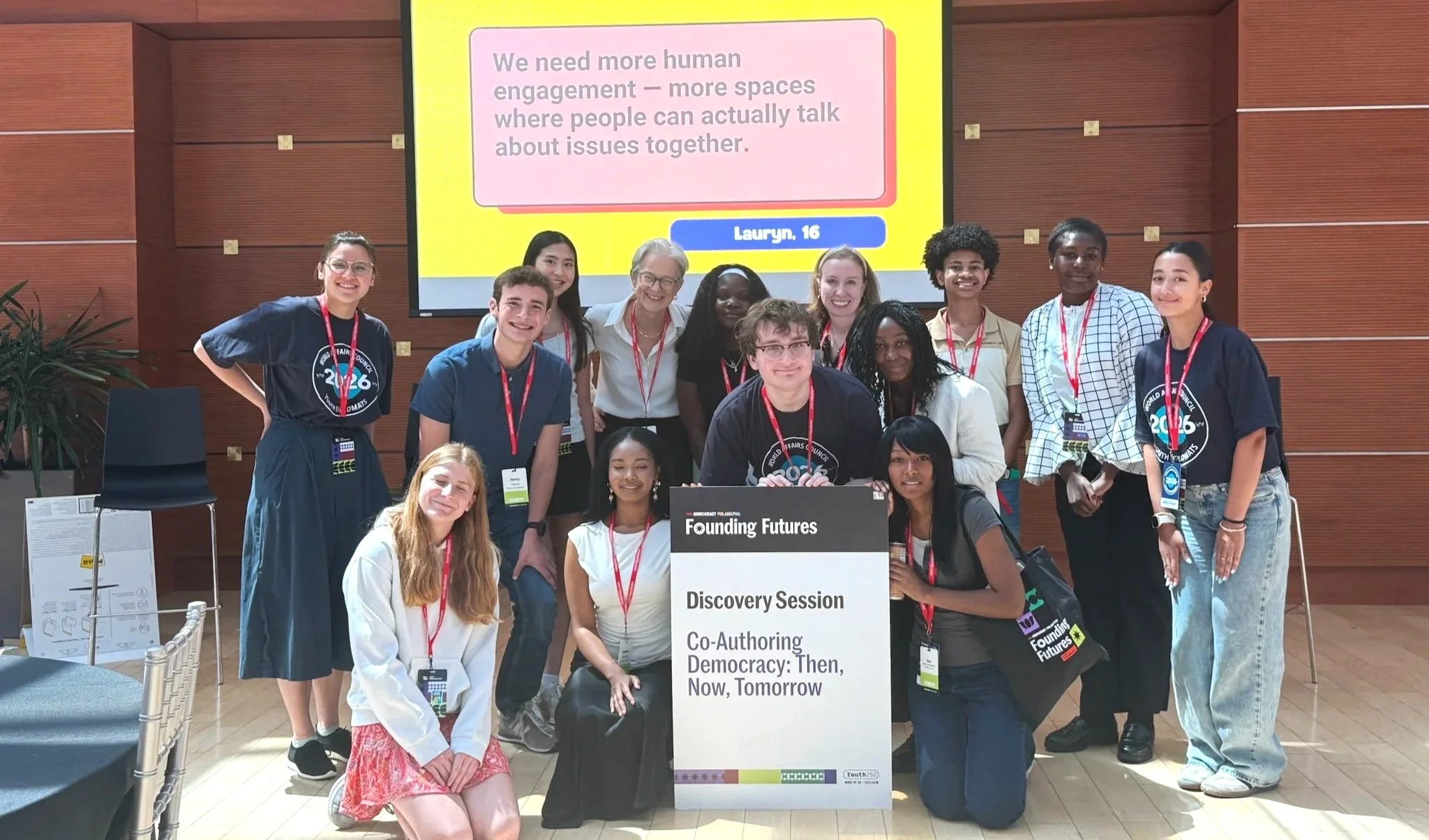
A month before TED and Visit Philadelphia staged their big event on the future of democracy for America's 250th on June 13th, someone noticed that the day had no intergenerational session in it, no place where teenagers and adults would actually talk to each other. History Co:Lab and Made By Us were called to help. Fernande Raine, founder of History Co:Lab, and Caroline Klibanoff, executive director of Made By Us, would facilitate, but the design of the session would be placed in the hands of local teens. The venue provided was the stunning Hamilton Garden rooftop at the Kimmel Center for the Performing Arts–right over the TED stage, right before the talks.
Eight teenagers said yes. They came from the World Affairs Council of Philadelphia and the Independence Seaport Museum, and one of them was recruited off the sidewalk outside that morning. The model was drawn from the "Something in Common," series which the Co:Lab designed with the Henry A. Luce Foundation in Dallas and Pittsburgh this spring.
The teens decided to have the session be in three phases, starting with a discussion about artifacts that prompt conversation about history and democratic values. They each chose something entirely different, ranging from a poster about toxic masculinity and political extremism, to the crying man under the banner and the Constitution itself. Nobody handed them a list of safe topics, and they did not go looking for comfortable ones.
In the end, they called their Discovery Session "Co-Authoring Democracy: Then, Now, Tomorrow," and it sold out days ahead with a waitlist behind it. More than seventy-five adults got a seat and another thirty stood in the back. Meanwhile, downstairs in Marian Anderson Hall, 1,400 guests were filing in for a main stage of TED talks on everything from media literacy to AI and democracy, which is the architecture TED is built on: one person on a stage with an idea. But the teens, wanted to start with conversation.
As they pulled up the pictures of their artifacts and started with their conversation prompts, the adults leaned in and engaged. It was clear that this was very different from what teens report feeling every day–that they feel powerless, ignored, pigeonholed by adults who have stopped really seeing them. At these tables, no one was ignoring anyone, and conversation came naturally.
"I felt kind of equal to be able to share similar political opinions with people who are like five times my age," one of them said. Another had walked in braced for the opposite. "I thought I would feel more judged than I ended up feeling, because some adults might not think a teenager's opinion is really valuable." A third is used to getting brushed off when she raises hard things, but this table didn't. "The people at my table were receptive to what I was saying to them, and they gave me feedback. It was like talking to a friend."
The table with the image of the crying man became a conversation about historic memory and trauma, and it went exactly where she hoped it would. "I really appreciated that they kept an open mind and were willing to contribute their perspectives," she said. "I was super grateful to have that additional generational perspective."
What Democracy Looks Like With Teens at the Table
The session closed with a panel on what America would look like with more teen input. "America would definitely be more open to improving access for youth to be in leadership," one said. "There's nobody around really creating space for us to have a seat at the table."
A seventeen-year-old from Delaware County pointed at the room she was standing in. "I think America would be more representative of all voices, not just a couple voices, not just a few corporations. This is exactly what this event is achieving: we're being able to have these discussions."
"I think if my generation had more of a say, our democracy would be more honest," another said. "Adults tend to be a little more protective and hidden about their beliefs because they don't want to cause any problems socially. But young people are a little bit bolder about what we think. "
When the time was up, the adults did not want to leave, and lingered to talk and share their thoughts. “This was fantastic!” a woman remarked, “I wish I could just keep doing this all day”. Although the sprint of prep and execution had been exhausting, the teens afterwards were elated.
"I feel kind of relieved," one said. "Not just relieved, but like we were able to get something out there that actually got people talking." Another talked about connection and belonging. "I feel connected with people. It really was able to develop a strong relationship with the people, and have a good conversation." A third put it simply: "It made me feel hopeful. Being in a space like this where people were just very open, it feels different."
And one of them was still buzzing. "I feel super exhilarated now that it's over, and I've had the opportunity to connect with so many people from different backgrounds and different age groups."
"This is the kind of thing that should be happening in every public space, all the time," Klibanoff said. “More than a hundred adults came off that rooftop having spent a morning taking teenagers seriously–why isn’t this just the norm?”
“This is the kind of thing that should be happening in every public space, all the time. We have been hearing this all over America.”
Caroline Klibanoff, Director of Made By Us
A follow-up survey measured the change: all eight co-designers came back more heard, more connected to what democracy is supposed to be, more able to change it. One of them wrote that she walked in hopeless and walked out hopeful. All of this confirms just how simple, in the end, it really is to rewire democracy. The only thing we need to do is show up for one another and engage in aspiration for what could be with open hearts and minds.

We Believe in the
Power of Co
Join Us in Empowering the Future