
Latest + Greatest
June 2026
Co-Authoring Democracy:
Teens Take the Table at TED Democracy Philadelphia
A month before Visit Philadelphia and TED staged their flagship event on the future of democracy for America’s 250th birthday, someone noticed that the day-long program didn’t have an intergenerational session to engage teens in the conversation.
Once that gap was flagged, organizers moved fast. History Co:Lab and Made By Us were brought in on short notice to design and run a youth-led session inside the event, using a same co-design model that had just shaped teen-led "Something in Common" gatherings they crafted in partnership with the Henry A. Luce Foundation in Dallas and Pittsburgh earlier this spring. The rule was that young people, not adults, would design the session themselves.
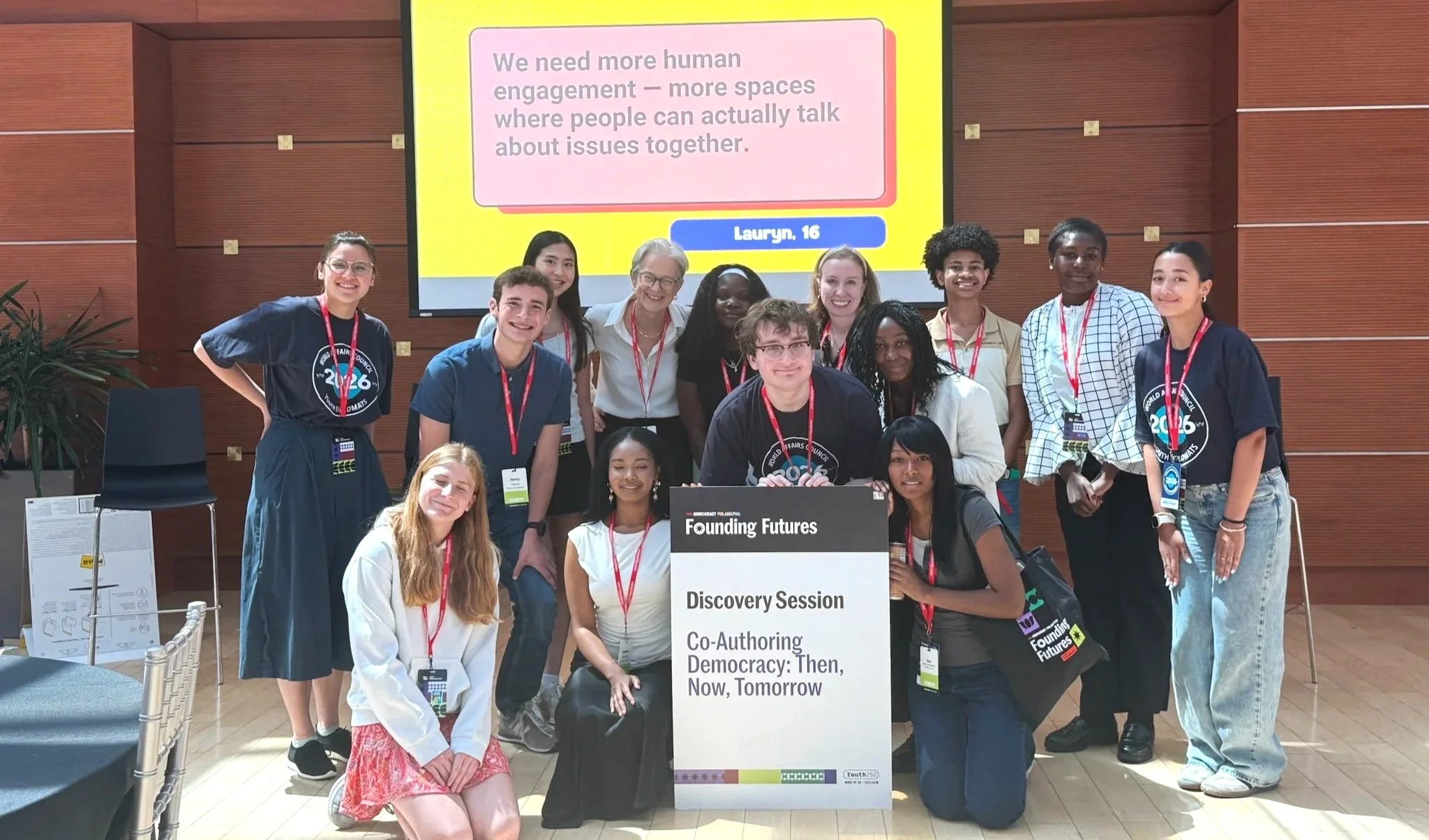
The result was "Co-Authoring Democracy: Then, Now, Tomorrow," a Discovery Session co-led by a group of 8 teens, facilitated by Fernande Raine, founder of History Co:Lab, and Caroline Klibanoff, executive director of Made By Us. It was the morning session kicking off the celebratory edition of TED Democracy held June 13 at the Kimmel Center for the Performing Arts. More than 1,400 guests came through the Kimmel Center that day for a main stage lineup of TED talks in Marian Anderson Hall on everything from media literacy to AI's intersection with democracy.
On the rooftop in the festive penthouse of Hamilton Garden, the format didn’t celebrate individual ideas, but the voices of young people themselves. Eight teenagers — drawn from the World Affairs Council of Philadelphia, the Seaport Museum, and at least one walk-on recruited straight off the street — had co-designed a Discovery Session that put them in charge of small tables of adults two and three times their age. Each table was anchored by a single museum artifact: the 19th Amendment and the fight for suffrage, a portrait used to open a conversation about toxic masculinity and political extremism, an image from the George Floyd protests, the Constitution itself. The session sold out days in advance, with a waitlist of adults still hoping for a seat. More than 75 adults ultimately found their way to a table.
Artifacts as an Opening
The teens didn't just host the conversations — they set the terms of them. One student picked a portrait of a crying man beneath a banner reading "heal," using it as a way into a harder subject.
"I think when I brought up the toxic masculinity as kind of a gateway into how political extremism is being embraced by both sides, I wasn't sure how that was going to go over with people," the student said afterward. "But I think I really appreciated that they kept an open mind and were willing to contribute their perspectives... I was super grateful to have that additional generational perspective."
Reflections the teens wrote on quote cards during the day captured the same instinct to look outward rather than inward:

Gen Z is coming outside and talking about issues facing the world. They're not just sitting down waiting for something to happen — they're taking it into their own hands.
- Ipa | 16
If my generation had more of a say, America would be less focused on internal politics and more focused on the unification of people around the globe.
- Estelle | 13
We need more human engagement — more spaces where people can actually talk about issues together.
- Lauryn | 16
What it Felt Like to Lead the Conversation
The teens didn't just host the conversations — they set the terms of them. One student picked a portrait of a crying man beneath a banner reading "heal," using it as a way into a harder subject.
"I think when I brought up the toxic masculinity as kind of a gateway into how political extremism is being embraced by both sides, I wasn't sure how that was going to go over with people," the student said afterward. "But I think I really appreciated that they kept an open mind and were willing to contribute their perspectives... I was super grateful to have that additional generational perspective."
The teens didn't just host the conversations — they set the terms of them. One student picked a portrait of a crying man beneath a banner reading "heal," using it as a way into a harder subject.
"I think when I brought up the toxic masculinity as kind of a gateway into how political extremism is being embraced by both sides, I wasn't sure how that was going to go over with people," the student said afterward. "But I think I really appreciated that they kept an open mind and were willing to contribute their perspectives... I was super grateful to have that additional generational perspective."
For teens used to being invited to the table but not really heard at it, something about this format landed differently.
"I felt kind of equal to be able to share similar political opinions with people who are like five times my age," one student said. "Yeah, that's why it felt like equal for me."
Another admitted she'd braced for the opposite reaction: "I thought I would feel more judged than I ended up feeling, because some adults might not think that a teenager's opinion is really valuable. So I thought people would judge me more than what it did."
A third had expected to get shut down, the way she said she often does when she raises hard topics: "The people at my table were receptive to what I was saying to them, and they gave me feedback... it was like talking to a friend."
Even the scale of the room surprised them. "It was inspiring to see so many people like two or like three times my age that were so willing to come and listen and like pay money to hear our opinions and stand in the back," one student said. Another put it more simply: "I was surprised how natural the conversation felt."
How They Felt Walking Out
Right after the session ended, the teens gathered for a quick debrief, still catching their breath. Asked simply how they felt, the answers came fast and unguarded.
"I feel kind of relieved," one student said. "Not just relieved, but also like we were able to get something out there that actually got people talking."
"I feel connected with people," said another. "I feel like it really was able to develop a strong relationship with the people... and have a good conversation."
One student said the openness of the room caught her off guard, in a good way: "It made me feel hopeful, and like being in a space like this where people were just very open, it feels different... whenever I'm in a space like this and people are having open conversations, it makes me feel hopeful."
"It was very inspiring seeing everyone talk so openly and educated," another added, while a tablemate reflected on what the format had made possible: "It was very thought-provoking... I think we can start making ways towards progression in the way we talk to each other."
By the end, the exhaustion had turned into something closer to elation. "I feel super exhilarated now that it's over," one student said, "and I've had the opportunity to connect with so many people from different backgrounds and different age groups. It's super exciting... I'm super happy and thankful that you gave us the opportunity to be part of this."
The Numbers Behind the Feeling

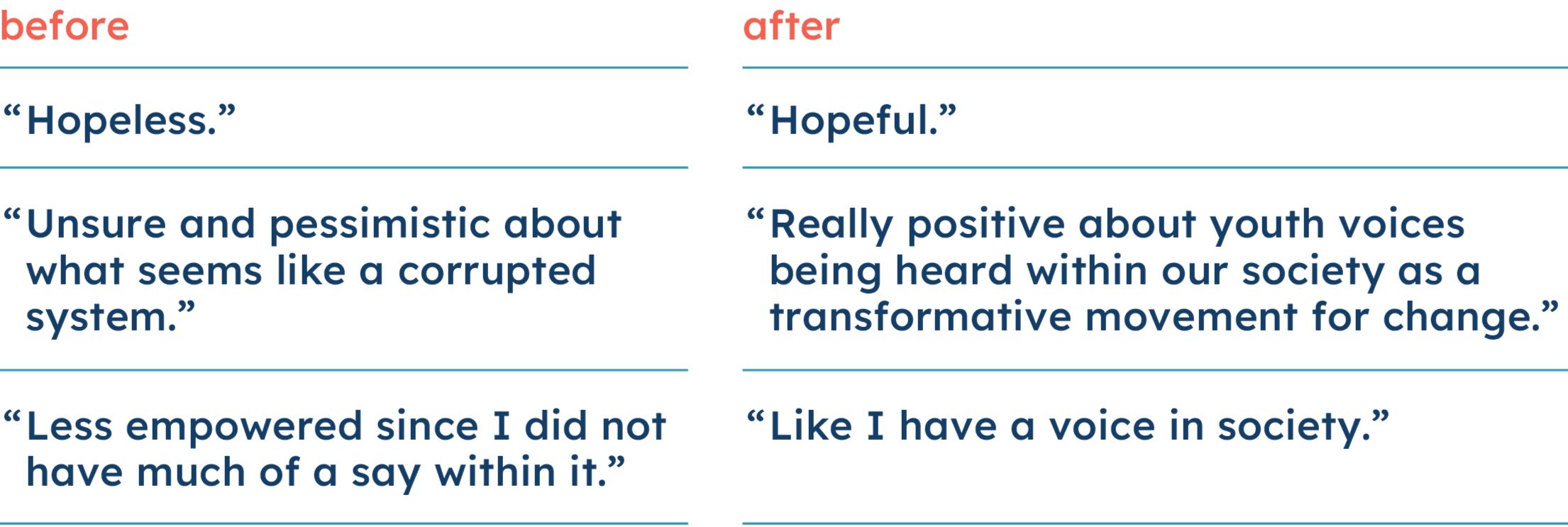
Asked how they felt about democracy before and after the session, the shift showed up in their own words:
A Closing Reminder
As the session wound down, Raine — who co-led the debrief alongside the teens — turned to her own history to explain why the artifacts on the tables mattered. She described standing in a square in East Berlin in 1988, still a teenager herself, watching plainclothes police pull hand-printed flyers out of people's hands, and pocketing one anyway because, as an American, she didn't think anyone could take it from her. It still hangs framed over her desk.
"These artifacts in the end are reminders of our role that we play in doing this kind of work," she told the group. "So I'm excited that you were here."
The model that ran in Hamilton Garden that day is the same one History Co:Lab has now tested three times in three cities this year — Dallas, Pittsburgh, and Philadelphia — each time putting teenagers in charge of the room and asking adults to actually listen. Judging by what the teens said walking out, it's a bet worth making again.

We Believe in the
Power of Co
Join Us in Empowering the Future